


SRT Animation
SRT animation means Scale-Rotation-Translation animation. In other words : how to animate the transformation of my nodes ?
Concept of a timeline
cgSceneGraph embed a complete animation engine based on
timelines and animation keys to
fulfill all the needs (I hope :)).
An animation key is a couple time/value, and define on a timeline the value of a property at
the given time.
Each value between 2 keys will be computed by the framework, based on the chosen
interpolation algorithm (« linear » is the only interpolation method available on the v1 of
cgSceneGraph).
Example of a timeline with 3 animation keys :

Animate a node
There are 2 methods to create an animation in the framework:
this.sceneGraph.addAnimationKey(myNode, « property », time, value);
this.sceneGraph.animate(myNode, « property », 45, valueFrom, valueTo, « linear », 0, true);
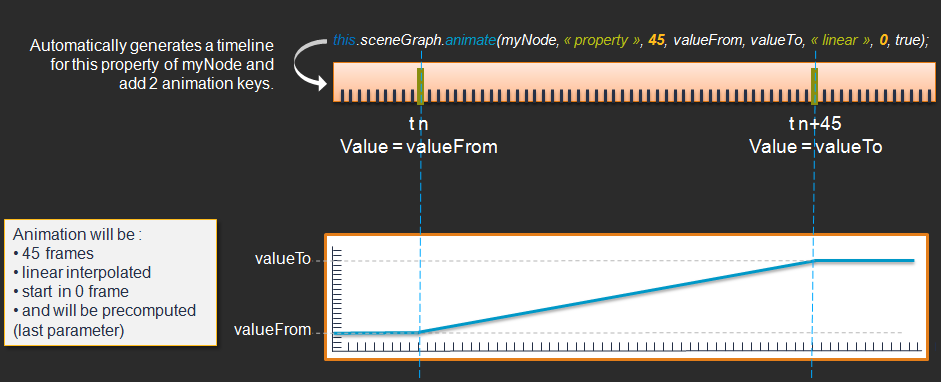
Almost everything is animatable in cgSceneGraph, if the
property is a number. So you can not animate the position of a node in 1 call, you have to
animate position.x and position.y
That's logical, because may be you don't want to
animate x and y the same way...
For examples:
                                    //animate x position during 30 frames, from 0 to 200, starting in 0 frame
                                    this.sceneGraph.animate(this.squareNode, "position.x", 30, 0, 200, "linear", 0, true);

                                    //animate y position during 30 frames, from 0 to 200, starting in 0 frame
                                    this.sceneGraph.animate(this.squareNode, "position.y", 30, 0, 200, "linear", 0, true);

                                    this.sceneGraph.animate(this.squareNode, "rotation.angle", 30, 0, Math.PI, "linear", 0, true);

                                    //animate opacity from 0 to 1, in 30 frames and starting in 15 frames, without precomputing values
                                    this.sceneGraph.animate(this.squareNode, "globalAlpha", 30, 0, 1, "linear", 15, false);

                                    //animate red component of the color from 0 to 255, in 100 frames and starting in 0 frame (now)
                                    this.sceneGraph.animate(this.squareNode, "color.r", 100, 0, 1, "linear", 15, true);
Animation events
As in cgSceneGraph the animation is managed by a timeline, so
events related to the animation are also managed by this one.
There are 3 events for an animation:
- onAnimationStart
- onAnimate
- onAnimationEnd
To call an animation event you, so, first have to get the corresponding timeline and then register the event.
This can be achieved in one line like this:
                                    //assuming you have an animation on the couple squareNode/"rotation.angle"
                                    this.sceneGraph.getTimeline(squareNode, "rotation.angle").onAnimationStart = function (event) {
                                        console.log("animation started");
                                    };